
Table of Content
Why trust me on free running apps?
I‘m not a professional running coach — and I’ll never pretend to be. What I am is someone who has been running since 2016, logged over 360 miles on Runkeeper alone, completed two half marathons, and actually used every app on this list with my own two feet and my own phone. I’ve been a beginner.
I know what it feels like to not know your pace from your cadence, to get out of breath after two minutes, and to wonder if you’re even doing it right.
I write about running from the perspective of a real, everyday runner — someone who runs for joy, for mental health, and to prove to herself she can. Not for a podium finish. That means when I tell you an app is great for beginners, it’s because I actually found it great as a beginner, not because a press release told me so. Everything on this page is my own honest experience.
TLDR: What’s the best free beginner running app?
If you’re more of a visual person (same, honestly), I made a little explainer over on my TikTok breaking down exactly how these free running apps for beginners work in the real world — none of the jargon, just me actually using them and telling you what I think. I compared Nike Run Club vs Strava so you can see what each free running app actually looks and feels like before you download anything. Sometimes it’s easier to see it than read about it.
It’s had 190K views so I hope it helps you!
@misskatieruns Honest take on running apps for beginners… the best running apps for beginners? Are free!! Heres my pros and cons on the running apps I’ve used: @Strava @Runkeeper and Nike Run Club.. And my take on Runna.. it’s not free though. Hit follow for more tips on running apps! #runningapps #runna #strava #runningapp #nikerunningapp #runkeeperapp
What are the best free running apps for beginners?
RunkeeperStrava
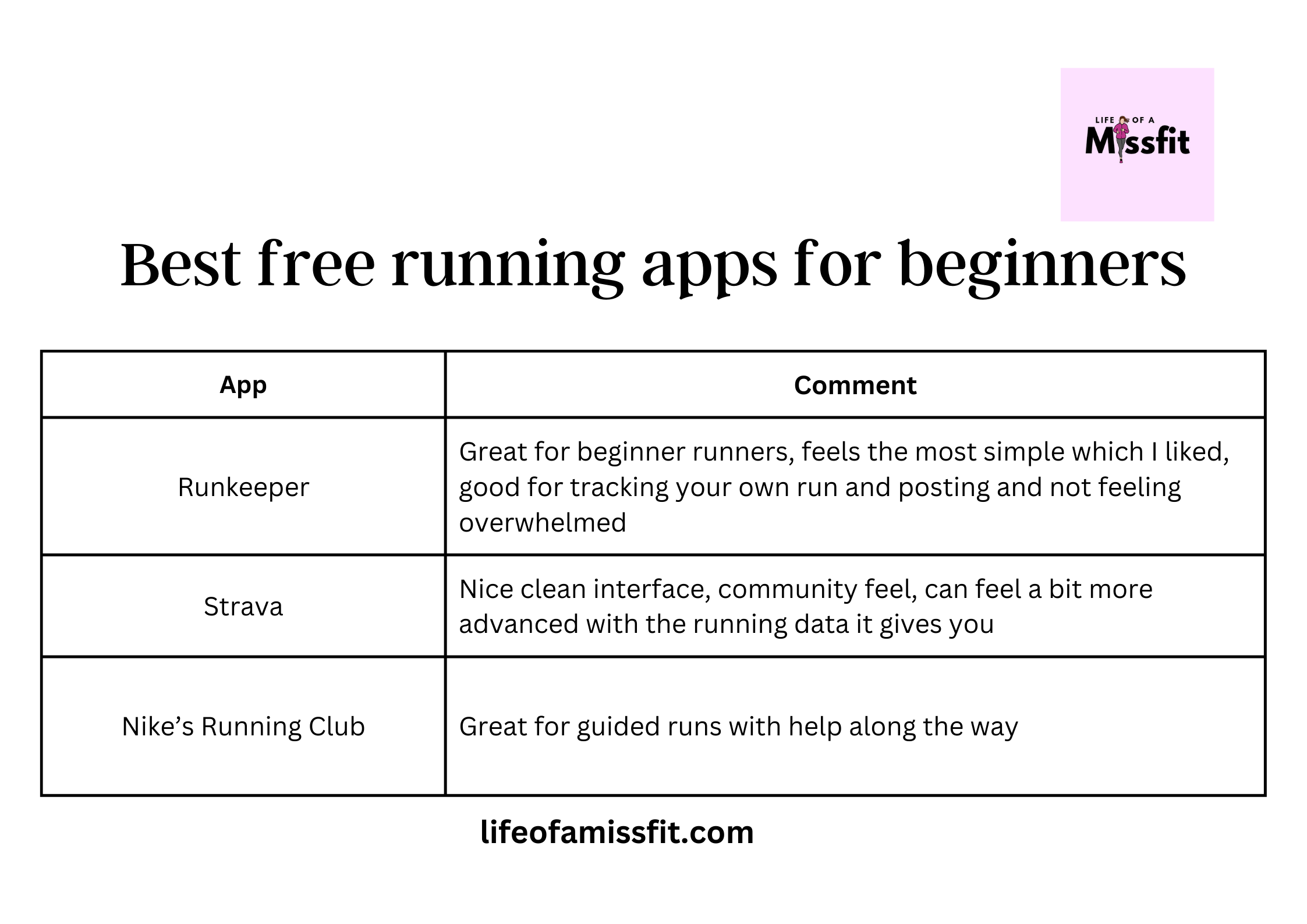
| App | Comment |
| Great for beginner runners, feels the most simple which I liked, good for tracking your own run and posting and not feeling overwhelmed | |
| Nice clean interface, community feel, can feel a bit more advanced with the running data it gives you | |
| Nike’s Running Club | Great for guided runs with help along the way |
So you’ve just started running, or you’re thinking about it, and you’re not sure how to get motivated to run. How do you even know what pace to run, and where to start with the whole concept without, well… getting totally out of breath and throwing the towel in.
I got you. It might not seem like it but running can be simple (and affordable) to get started!
You don’t have to pay expensive membership prices or subscribe to fancy clubs. You can just download a completely free running app for beginners…
And there’s lots of them! So here’s a breakdown of the good free running apps I’ve used and my opinions.
- Runkeeper
- Strava
- Nike Running Club
Runkeeper
Here’s some pros and cons of Runkeeper. Overall I found it a really good app as a beginner runner; not quite as beautiful and friendly as Strava (which we’ll get to next). But it lasted me a while!
| Feature | Pros | Cons |
| Interface | Very user-friendly and easy for beginners to navigate. | Social features are not as prominent or engaging as Strava. |
| Workouts & Plans | Offers guided workouts and training plans suitable for various fitness levels, including beginner running plans. | Some advanced training plans are locked behind a paid subscription. |
| Feedback | Good audio cues provide helpful real-time feedback during runs. | |
| Integration | Integrates well with a wide variety of other fitness apps and wearables. | |
| Motivation | Offers challenges and virtual races for motivation. | Segment feature is not as robust as Strava’s. |
| Analytics | Detailed post-run statistics and progress tracking. | Some advanced analytics are locked behind a paid subscription. |
My experience: I started using Runkeeper when I very first started running, in 2016. It was literally a way for me to keep track of my runs. Not the pace, cadence or any other fancy running data or jargon. I’d go for a run, track it, and then post a selfie afterwards.
And for what I wanted it for, was pretty great. I tracked over 360 miles on it!
Join the Runkeeper app.
Strava
Here’s the pros and cons of Strava as a beginner runner app. Overall I find it really easy to use to track my run (which is the most important part).
I think if you’ve never run before, it might be worth starting with Runkeeper (or Couch to 5K, for UK-based readers) because Strava can give you lots of more advanced running data even in its free version; that’s very helpful when you’ve found your flow and want to get more serious, but might be more confusing and a little off-putting to newbies.
| Feature | Pros | Cons |
| Social | Strong social features, allowing you to connect with friends and other runners for motivation and encouragement. | Can feel very competitive due to the emphasis on segments and leaderboards, which might be demotivating for some beginners. |
| Segments | Offers segments, which allow you to compare your times on specific stretches of road or trail. | |
| Analytics | Detailed activity recording and analysis, including pace, heart rate (if monitored), and cadence. | Free version has limited access to some advanced analytics. |
| Integration | Compatible with many devices. | |
| Free Version | Free version offers significant functionality. | Free version has limited access to some training plans. |
| Interface | Interface can feel a bit overwhelming with all the features, especially for new users. |
My experience: I’ve joined Strava only in the last couple of months; my full Strava profile is here. I like that you can connect with your friends on there (a few of my running friends on Instagram joined me!), and they can give you ‘kudos’ when you post your run which is cool.
Nike Running Club
Here’s some pros and cons for the Nike’s free running app.
| Feature | Pros | Cons |
| Guided Runs | Excellent guided runs led by Nike coaches, offering motivation and tips. | Less focus on detailed post-run analytics compared to Runkeeper and Strava. |
| Training Plans | Offers structured training plans designed by Nike experts for various goals and levels. | Segment-like feature is not as developed as Strava’s. |
| Community | Strong emphasis on community through clubs and challenges. | Integration with non-Nike devices can sometimes be less seamless. |
| Motivation | Tracks progress and achievements with badges and milestones. | Some users may find the coaching style not to their personal preference. |
| Integration | Integrates well with Apple Watch and other wearables. | |
| Interface | Visually appealing and intuitive interface. |
My experience: I only actually use Nike’s Run Club app a couple of times. I wanted to try something different from the likes of Runkeeper and Strava, just to see what other running apps are like.
Nike’s guided runs
And it’s definitely really helpful if you want to go for a specific mileage like you’re training for a 5K. Because it’s already got a bank of guided runs; that’s the best part. You can still have your own music on, and then every so often a pre-recorded voice will do a ‘check in’.
I’ve been running since 2016 and that was really helpful – Runna might have this too, but you have to pay after the first week! It felt like a friend checking in on the side lines.
What’s great is the person you’ll listen to, is a fully qualified running coach of some description; not an AI voice or a random narrator. They’ll give you a little pep talk to see how you’re feeling, advice on how fast you should be going, and some pointers on how to check your form.
The only thing I felt Strava and Runkeeper had that Nike’s RC missed, in my opinion, was the interface of keeping a track of your own runs – with those I can log in and straight away see my last run at an ease glance. Whereas Nike’s RC is very much a bank of free guided runs.
Other good free running apps for beginners
- Runna
- Couch to 5K
Couch to 5K (For UK readers)
There’s the UK Based NHS Couch to 5K. This can be a great shout for people with no running experience; it does what it says on the tin! So if you’re in the UK, that would be a good potential option for you, and again is free.
Runna
I have heard a lot about Runna. It’s a completely tailored running app for complete beginners. So it will help you with audio cues when you’re on your run to know when to speed up, when to relax again, etc.
I’ve seen SO many people use this, and really rave about it. I’ve heard things like
“I couldn’t have done this without Runna”
or
“I improved my 5k/half marathon pace by X minutes with Runna”.
But to be completely honest, as far as I’m aware, there’s a free trial for a week and then after that you have to pay £15.99 a month. So for two reasons I’ve not signed up:
- When I first started running, I didn’t want to pay a penny!
- It felt too focused on improving (and running should primarily be about joy..)
Who knows, maybe one day I’ll move over to the dark side and cough up. But I quite like running for free and sharing all my experience and tips with you!
So those are my recommended running apps.. anything else?
Free running podcasts for beginner runners
Maybe you’ve got a run tracking app. What else is there?
There’s a lot of free information out there if you’re taking the very first steps in your running journey.
The Running Channel has a great (free) podcast. Here’s what they have to say:
‘Olympic runner’ Andy, ‘average runner’ Sarah and ‘passionate park runner’ Rick sit down every week to bring you the latest news from the world of running and answer all of your running-related questions.
I’d also recommend Running Explained. It’s ran by the founder, Coach Elisabeth, who is all about the concept:
Transform your run,
transform your life.
She explains the science of running but in a really digestible way!
My honest verdict
If someone asked me today — knowing what I know after nearly a decade of running — which free running app to download first, I’d say Strava, without hesitating too long; Runkeeper is a close second.
Here’s why. When you’re just starting out, what keeps you going isn’t data — it’s the feeling that you’re making progress and that someone’s cheering you on. Strava nails that. The interface is clean and satisfying to use, posting your first run feels like a little win, and the community element (even just a few friends giving you kudos) is genuinely motivating in a way that a solo tracker isn’t.
The free version gives you everything a beginner actually needs — GPS tracking, route maps, pace and distance data — without bombarding you with advanced metrics you don’t need yet. Yes, it shows you more data than Runkeeper, but I think that’s actually a good thing now I reflect on it; you learn what things like cadence and elevation mean gradually and naturally, rather than having it hidden from you.
It’s also just… satisfying to use. And when you actually enjoy opening an app, you’re more likely to keep running. That’s the whole point.
That said — if you are a true complete beginner and the idea of any running data feels intimidating, start with Runkeeper or Couch to 5K and migrate to Strava once you’ve found your feet. There’s no wrong answer here.
Not affiliated with any of the above.
Written by Katie McDonald, 8th May 2025, Updated 1st May 2026.
Instagram | Runkeeper | Facebook | X (Formerly Twitter) | LinkedIn
