Let me start with the most honest thing I can say about 5K times: the only good 5K time is the one where you actually ran a 5K.
I know that sounds like a cop-out. But I’ve been running for over ten years, I’ve done two half marathons, and I still clock in at around 32 minutes for a Parkrun. By some of the benchmarks floating around the internet, that puts me firmly in the beginner bracket. And I genuinely could not care less.
That said — you’re here because you want to know what the numbers mean. Whether you’re comparing yourself to averages, setting a goal for your first 5K race, or just curious where you sit — I’ve got you. Here’s everything you need to know about 5K times, broken down properly, with no nonsense.
Table of Content
Table of Contents
- How many miles is a 5K?
- What is a good 5K time?
- Average 5K times by age and gender
- Is 30 minutes a good 5K time?
- What affects your 5K time?
- Is running a 5K hard for beginners?
- How to improve your 5K time
- 5K and Parkrun
- What is the world record for 5K?
- FAQs
How many miles is a 5K?
A 5K is 3.1 miles. Easy one to start with.
If you’re used to thinking in miles rather than kilometres (very British of us), that’s roughly the length of a big park loop, or about 30 to 40 minutes of running depending on your pace.
What is a good 5K time?
Here’s a general breakdown of 5K times by ability level. These are broad benchmarks — they’re a rough guide, not a verdict on your worth as a human being.
| Level | Women | Men |
|---|---|---|
| Beginner | 30–40 minutes | 25–35 minutes |
| Intermediate | 25–30 minutes | 20–25 minutes |
| Experienced | 20–25 minutes | 15–20 minutes |
| Elite | Under 18 minutes | Under 15 minutes |
A quick note on these tables: they’re averages based on general population data. Your age, fitness history, the terrain you’re running on, and whether it’s a race or a training run all affect where you land. Don’t take them as gospel — take them as a starting point.
My own Parkrun time sits around 32–33 minutes, which puts me at the beginner end of the women’s table. I’ve been running for over ten years. Draw your own conclusions about how much these benchmarks matter in the long run (pun intended).
Average 5K times by age and gender
This is the table most running websites don’t bother including — and it’s actually the most useful one, because pace naturally changes as we get older and that’s completely normal.
Women — average 5K times by age:
| Age Group | Beginner | Average | Experienced |
|---|---|---|---|
| 20–29 | 35–40 min | 30–34 min | 25–29 min |
| 30–39 | 35–40 min | 31–35 min | 25–30 min |
| 40–49 | 37–42 min | 33–37 min | 27–32 min |
| 50–59 | 40–45 min | 36–42 min | 30–35 min |
| 60+ | 43–50 min | 40–47 min | 33–40 min |
Men — average 5K times by age:
| Age Group | Beginner | Average | Experienced |
|---|---|---|---|
| 20–29 | 28–35 min | 24–28 min | 19–23 min |
| 30–39 | 29–36 min | 25–29 min | 20–24 min |
| 40–49 | 31–38 min | 27–31 min | 22–26 min |
| 50–59 | 34–41 min | 30–35 min | 24–29 min |
| 60+ | 38–46 min | 34–40 min | 27–33 min |
These are approximate population averages. Individual results vary widely.
The most important thing these tables tell you is that running a 5K in 35 minutes as a woman in your 40s is completely normal. The goalposts shift with age — and that’s not a reason to slow down, it’s a reason to stop comparing yourself to a 25-year-old’s benchmark.
Is 30 minutes a good 5K time?
Yes — genuinely, yes. Especially for beginners.
A 30-minute 5K means you’re running at roughly a 9:40 per mile pace, which is a solid, comfortable running pace. It puts you in the average-to-intermediate bracket for most adult women, and the intermediate bracket for men.
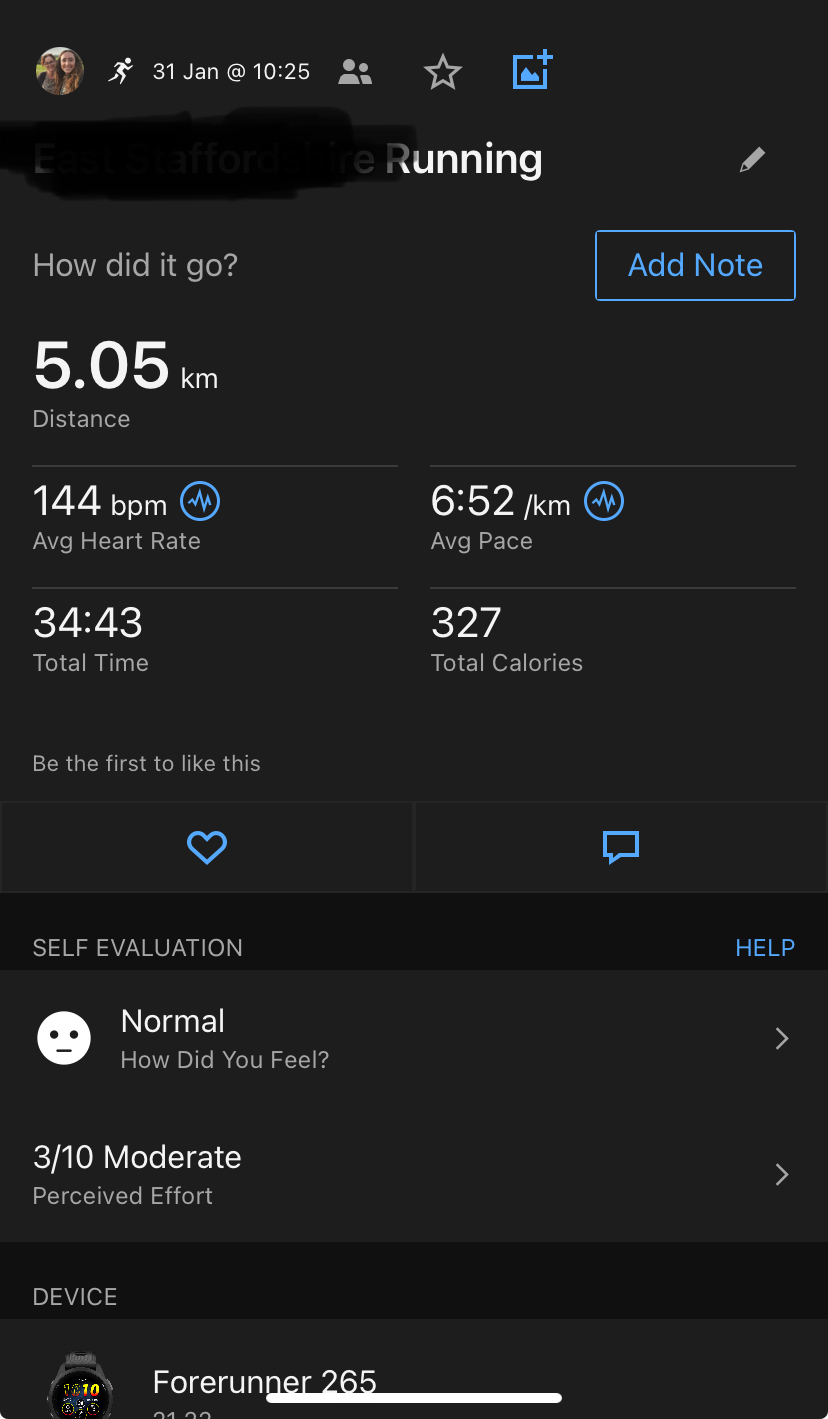
My most recent Parkrun was 32:43, tracked on my Garmin Forerunner 265. I was training for a half marathon at the time and I wasn’t racing it — I was just running at a comfortable effort. And honestly? 32 minutes feels fine to me. I came home, had breakfast, and felt great about it.
Don’t let anyone tell you 30 minutes isn’t good enough. It absolutely is.
What affects your 5K time?
There are a few things that genuinely move the needle on your 5K time — and a few that people stress about that really don’t matter as much as you’d think.
The things that actually matter:
Your current fitness base. How consistently you’ve been running in the weeks and months before matters more than almost anything else. A body that’s used to running regularly will perform better than one that hasn’t run in a month, regardless of talent or effort on the day.
How you pace yourself. Going out too fast in the first kilometre is one of the most reliable ways to have a miserable 5K. Most beginners do it. Most beginners regret it around the 3K mark when their legs have turned to concrete. Start slower than you think you need to. You can always push at the end.
Sleep. I bang on about this a lot because it’s genuinely underrated. Sleep is when your body recovers and adapts to training. If you’ve had three rubbish nights in a row, your legs will tell you about it.
What you ate beforehand. Running on empty or running on a full stomach are both miserable experiences. I run best about two hours after a light meal or snack. My go-to before a longer run is a cinnamon and raisin bagel with peanut butter — quick energy, not too heavy. For a 5K specifically, even just a banana thirty minutes before is enough.
The course and conditions. A flat road 5K and a hilly trail 5K are completely different experiences. Wind, heat, and rain all affect your time. Don’t compare a sweaty summer 5K to a crisp October race day and feel bad about the difference.
The things that matter less than you think:
Your age (within reason), whether you’re wearing the “right” kit, and what anyone else around you is doing. Run your own race.
Is running a 5K hard for beginners?
Honestly? The first time, yes. A little bit.
But here’s the thing — hard doesn’t mean impossible, and it doesn’t mean it’s not for you. Every single runner, from complete beginner to seasoned marathoner, found their first 5K hard. The lungs take time to adapt. The legs take time to adapt. Your brain takes time to stop filing complaints.
The run-walk method is your best friend if you’re new to this. Instead of trying to run the whole thing without stopping, alternate between running and walking — run for two minutes, walk for one minute, repeat. Over a few weeks, the running intervals get longer and the walking intervals get shorter, until suddenly you’re running the whole thing and you’re not entirely sure when that happened.
I started with my dad as a teenager, running to the next lamp-post and walking back. That’s genuinely where it began. Now I run half marathon training distances. The 5K was just the start.
If you can walk 5K, you can run 5K. It just takes a bit of time to get there, and that’s completely fine.
How to improve your 5K time
Right — here’s what actually works, from someone who has tried most of it.
Run more consistently. Not longer, not harder — just more regularly. Three runs a week, week after week, will do more for your 5K time than one heroic long run every fortnight. Consistency beats intensity every time at this level.
Add one slightly harder session per week. Once you’ve been running regularly for a few weeks, try adding one run where you push slightly harder than usual — not all-out sprinting, just a bit more effort than your easy runs. Even just picking up the pace for the last five minutes of a run teaches your body to work harder.
Prioritise sleep. Genuinely. I know I’ve said this already but your body does its adapting while you sleep. If you’re running three times a week and sleeping badly, you’re leaving a lot of improvement on the table.
Eat well around your runs. You don’t need a complicated nutrition plan for 5K training. Eat a proper meal a few hours before your harder sessions, make sure you’re not running on empty, and eat something with protein and carbs within an hour of finishing.
Track your runs. I use Strava now (I switched from Runkeeper in 2025 and wish I’d done it sooner). Being able to look back at your runs over weeks and months and see the progression — the distances getting slightly longer, the paces gradually improving — is quietly motivating in a way that running without tracking isn’t. You don’t need anything fancy. Your phone GPS is enough to start.
Do Parkrun. Seriously — see the next section. Running in a group setting, even casually, tends to naturally push your pace just enough to produce improvements over time. The regular weekly format means you get genuinely comparable data from week to week, which is the best possible way to track your 5K progress.
Easy hack to run a sub 30 minute 5k
I ran a sub 30 minute 5k in 2025. Here’s a TikTok video on what made the biggest difference for me!
@misskatieruns Hack – watch to the end for how to run a sub 30 minute 5k…. This is how!!! #5krun
5K and Parkrun
If you haven’t done a Parkrun yet, it is — in my completely unbiased and totally objective opinion — one of the best things you can do for your running.
Parkrun is a free, weekly, timed 5K that happens in parks across the UK (and in many other countries) every Saturday morning at 9am. It’s organised by volunteers. There’s no entry fee. There’s no minimum pace. The tailwalker always finishes behind you.
I’ve been doing Parkrun for just over a year now and it’s changed how I think about the 5K distance entirely. There’s something about running with other people on a familiar course every week that makes the 5K feel less like a test and more like a habit. Some weeks I push. Some weeks I just plod round and enjoy the fresh air. Both are fine.
My most recent Parkrun time was 32:43. I know some people in that same run finished in under 20 minutes. I also know some people finished after me, and some people walked the whole thing. Everyone gets the same finish token. Everyone gets their time emailed to them. The Parkrun community is one of the warmest, most unpretentious running communities I’ve ever come across.
If you want a really honest measure of your 5K progress over time, do Parkrun regularly. Same course, same conditions (roughly), same start time every week. The data becomes genuinely useful.
You can find your nearest Parkrun and register for free at parkrun.org.uk. Registration takes five minutes and your barcode is yours forever. I’ve written a guide on how to do Parkrun here.
What is the world record for 5K?
Men’s 5K world record (track): Joshua Cheptegei (Uganda) — 12:35.36, set in Monaco in August 2020.
Women’s 5K world record (track): Gudaf Tsegay (Ethiopia) — 14:00.21, set in Eugene in 2023.
These are the world athletics track records. Road 5K records are slightly different. Both are, frankly, incomprehensible to me as a 32-minute Parkrunner, and I mean that with complete admiration.
For the most current world records, always check the World Athletics website directly as these can be updated.
FAQs
What is a good 5K time for a beginner?
For a beginner, anything between 30 and 40 minutes for women and 25 to 35 minutes for men is completely normal and genuinely good. If you’ve never run a 5K before and you finish one in under 40 minutes, that’s a real achievement — don’t let anyone tell you otherwise. The best 5K time for a beginner is the one where you actually got out the door and ran it.
What is the average 5K time for women?
The average 5K time for adult women is roughly 30–35 minutes, depending on age and fitness level. Women in their 20s and 30s tend to average around 30–34 minutes. That average increases slightly with each decade, which is completely normal. My own Parkrun time of 32:43 sits right in that average range — and I’ve been running for over ten years, which tells you everything you need to know about not stressing over these numbers.
Is a 5K hard to run?
For complete beginners, the first 5K feels hard — mostly because your lungs and legs aren’t used to it yet. But hard doesn’t mean impossible, and it gets significantly easier within just a few weeks of regular running. The run-walk method (alternating between running and walking intervals) is a great way to get through your first few 5Ks while your body adapts. Within a few weeks of consistent running, most people find they can cover 5K without stopping.
How long does it take to run 5K?
At a comfortable beginner pace, most people take between 30 and 40 minutes to run a 5K. At an intermediate pace, you’re looking at 25 to 30 minutes. At an experienced runner’s pace, under 25 minutes. The time genuinely varies enormously based on fitness, age, terrain, and whether it’s a race or a training run — so don’t put too much weight on a single time.
What’s a good 5K time for my age?
This depends on both your age and gender — see the full age-graded table earlier in this article for a proper breakdown. The short version: the benchmark for what’s “good” shifts slightly as you get older, which is why comparing yourself to a 25-year-old’s time when you’re in your 40s isn’t particularly useful. Run against your own previous times, not someone else’s age group.
Will Parkrun improve my 5K time?
In my experience, yes — especially if you do it consistently. Running the same course week after week gives you genuinely comparable data, and running in a group naturally nudges your pace slightly harder than you’d push alone. I’ve been doing Parkrun for just over a year and my times have gradually come down. The fact that it’s free, social, and happens every Saturday at 9am also means you’re much more likely to actually turn up than you would be for a solo training run. Register for free at parkrun.org.uk.
Written by Katie McDonald — I’ve been running for over ten years, completed two half marathons, and I track all my runs on Strava.
Instagram | Strava | Facebook | TikTok
Disclaimer: This article may contain affiliate links. I may earn a commission.
