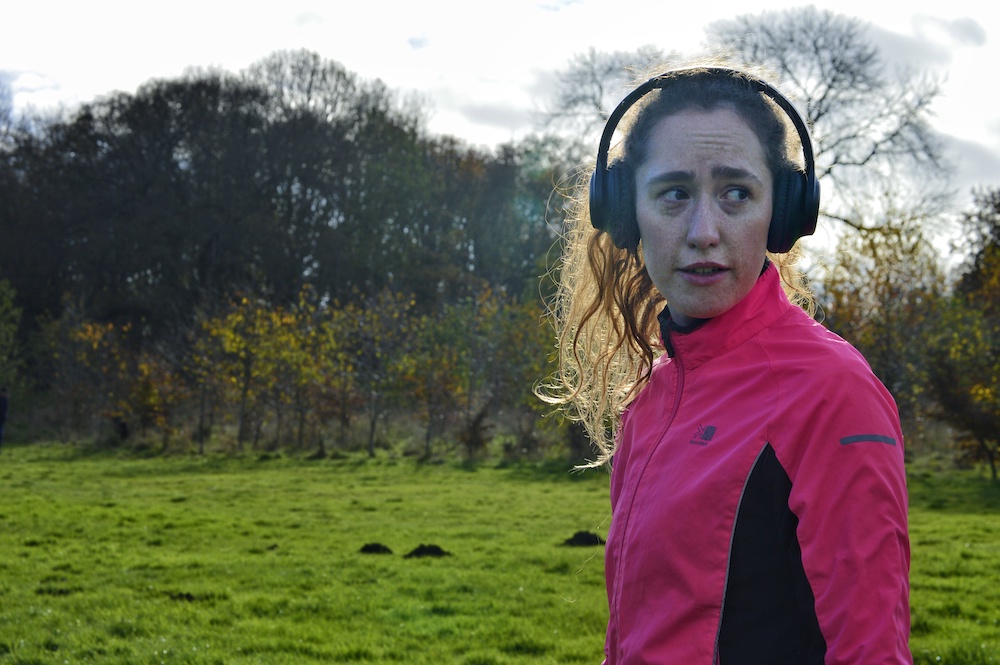

I’ve been running with headphones for years. And in that time, I’ve graduated through all three types — the wired earphones that constantly fell out, the big chunky over-ear headphones that kept my ears warm but probably weren’t ideal for traffic awareness, and now my Shokz bone conduction headphones, which I genuinely think are the best running headphones I’ve ever used.
So if you’re wondering whether you can run with headphones, which type is best, and whether it’s actually safe — I’ve got you. I’ve tried all of them, and I have thoughts.
Table of Content
Table of Contents
- Can you run with headphones?
- Types of running headphones
- Running with over ear headphones
- Running with wired earphones
- Running with bone conduction headphones
- Is it safe to run with headphones on?
- Can you run a race with headphones?
- Running without headphones
- What music is good for running?
- FAQs
Can you run with headphones?
Yes, absolutely. Millions of runners around the world run with headphones every single day, and I’ve been one of them for over ten years.
Whether you run with music, podcasts, audiobooks, or nothing at all is completely personal — but if you want to run with headphones, there is nothing stopping you. The right pair can genuinely transform a run. A good playlist has pulled me through miles I would have given up on otherwise.
The main consideration is safety, especially if you’re running on roads — and I’ll cover that properly below.
Types of running headphones
There are three main types of headphones runners tend to use:
Wired earphones — the classic. Cheap, widely available, decent sound. The problem is the wire, which snags, tangles, and pulls the earphones out at the worst possible moments.
Over ear headphones — the big chunky wireless ones. Secure, great sound, warm in winter. Not everyone’s first choice for running, but I used them for years and loved them. The downside is road safety — they can muffle outside noise quite significantly.
Bone conduction headphones — the newer option, and now my personal favourite. Instead of going into or over your ear, they sit just outside your ear and conduct sound through your cheekbones. You hear your music clearly and you can still hear everything around you. Game-changer for road running.
Running with over ear headphones
Here’s my honest take on running with over ear headphones, as someone who did it for years: they’re brilliant, with one caveat.
I used the Kvidio over ear headphones for a long time and genuinely loved them. The sound quality was great, they stayed on my head, and on cold winter mornings they doubled up as ear warmers — which is an underrated bonus when you’re heading out in January. The music felt immersive in a way that earphones don’t quite replicate. It was like having my own personal gig while I ran.
The pros of running with over ear headphones:
- No wires to snag or pull out
- Excellent sound quality
- Stay secure on your head
- Warm in winter
- Great for treadmill running where road safety isn’t a concern
The cons:
- Can muffle outside noise significantly, which matters on roads
- Can get sweaty underneath the ear cups on longer runs
- They’re bulkier than earphones or bone conduction headphones
- Some races don’t allow them (more on that below)
If you run primarily on a treadmill or on traffic-free routes like park paths and trails, over ear headphones are a perfectly good choice. On busy roads? I’d now choose bone conduction every time.
Running with wired earphones
Genuinely, I would not go back to wired earphones for running. Not a chance.
The problem is the wire. It catches on your arm when you swing it. It pulls the earphones out of your ears at exactly the moment you’re finding your rhythm. You lose your beat, your motivation, your train of thought — all of it — and then you have to slow down or stop to untangle yourself and put them back in.
That said, wired earphones are cheap and accessible, and if they’re what you have, use them. A run with slightly irritating earphones is infinitely better than no run at all. Just tuck the wire into your top to minimise the snagging.
Running with bone conduction headphones
This is where I’ve landed, and I don’t think I’ll be going back.
I bought my Shokz OpenRun Pro headphones for the Stratford Half Marathon — the race organisers require bone conduction headphones on road races for safety reasons, and I needed to adapt. I found a pair on Vinted for £86.99 (brand new, unopened — I was absolutely buzzing about that) and I’ve been using them ever since.
Bone conduction headphones work by sending vibrations through your cheekbones rather than into your eardrums. Nothing goes in your ear — they sit just outside it. And the sound quality is genuinely impressive. I was sceptical before I tried them, but I was completely wrong.
What makes them brilliant for running specifically:
You can hear traffic. This is the big one. I’ve been running in my Shokz and heard emergency vehicles approaching from streets I couldn’t see yet — vehicles I’d have completely missed in my over ear headphones. For road running, that awareness matters.
They don’t fall off. The Shokz wrap around the back of your head and sit very securely. I’ve done runs in wind, rain, and half marathon training distances and they haven’t budged.
They’re comfortable. There’s nothing pressing into your ear canal. After a long run in earphones, your ears can ache a bit — with bone conduction, that just doesn’t happen.
No sweat build-up. Over ear headphones can get uncomfortably damp on longer runs. Bone conduction headphones just… don’t.
They work with sunglasses and running watches. I run with my Garmin Forerunner 265 paired to my Shokz via Bluetooth, so my pace milestones come through the headphones as I run. They also sit perfectly alongside my running sunglasses with no interference.
I gave my Shokz 9/10 in my full review — the only thing I haven’t fully tested is the claimed 12-hour battery life (I haven’t done 12 hours of running in one go just yet). But everything else has been brilliant.
If you’re in the US, Shokz are widely available on Amazon. UK runners can find them at Argos, direct from shokz.com, or — as I proved — keep an eye on Vinted and Facebook Marketplace for a bargain.
Is it safe to run with headphones on?
The safety question is a fair one, and I want to answer it honestly rather than just saying “yes, fine, carry on.”
Running with any headphones that significantly reduce your awareness of your surroundings is a risk on roads. Traffic, cyclists, other pedestrians — these all matter. A good playlist can genuinely pull you into a zone where you stop registering what’s going on around you, and that’s not ideal when cars are involved.
My approach:
On roads: I use my Shokz bone conduction headphones so I can hear traffic clearly alongside my music. I keep the volume at a level where I can hear my surroundings. I don’t run with noise-cancelling headphones on busy roads.
On trails and in parks: I’m less strict. The over ear headphones come out on traffic-free routes and it’s fine.
Early mornings: I’m generally more aware anyway — fewer cars, quieter roads — but I still keep the volume sensible.
One earbud out is also a perfectly good solution if you’re using earphones and want to stay aware. Some runners always run like this and swear by it.
The bottom line: running with headphones is safe when you make sensible choices about volume, route, and the type of headphones you use. It’s not inherently dangerous. It’s about being aware of your environment.
Can you run a race with headphones?
This depends entirely on the race, and it’s worth checking before race day rather than finding out at the start line.
Many road races — particularly in the UK — either discourage or outright ban traditional headphones for safety reasons. The Stratford Half Marathon, which I’m training for, specifies that bone conduction headphones may be worn but standard headphones are not permitted. This is because the race is run on public roads and course marshals need runners to be able to hear instructions.
Some larger US road races take a similar position, though enforcement varies widely.
General rule of thumb:
- Trail races: usually fine, no restrictions
- Park-based 5Ks and 10Ks: usually fine
- Road races: check the race website specifically — look for their headphone or music policy in the FAQs
If your race does allow headphones, bone conduction headphones are your safest option — and increasingly the recommended type for road racing precisely because you can still hear marshals, other runners, and emergency vehicles.
@misskatieruns How to do parkrun with anxiety I wear headphones at parkrun because I have parkrun anxiety It makes me feel like I can do parkrun and zone out rather than compare myself to other runners!
Running without headphones
I want to give this section the space it deserves, because running without headphones is something I genuinely love — even though it took me a long time to appreciate it.
For years I was convinced that my music was what got me through a run. I was sure the bass of Tainted Love was what pounded my legs through miles. That Bruce Springsteen telling me I was Born to Run was what sparked off the endorphins. I dreaded the idea of going out without anything in my ears.
And then one morning, I went out without headphones — I think I’d forgotten them — and I was proved completely wrong.
Running without headphones does something different to running with them. It’s quieter, obviously. But it’s also strangely more present. You notice things you don’t notice when you’re in your music bubble. The sound of your own breathing. A bird. The specific silence of a main road at 6:40am before the commuters arrive.
I ran into my local town one morning and it was like a ghost town. The traffic lights were changing, but no cars were moving. No bleeping pedestrian crossings. Just me and the sun, creeping our way into the world together. And that’s when I got my reward — a sunrise.
It’s such a simple thing. But there’s something about a sunrise on a quiet morning run that makes you feel like you’re on holiday. Overwhelmed and peaceful at the same time. You see the same park in a completely different light — literally. The way the sun catches the edges of trees across a lake, the way everything is briefly golden and still before the day gets going. It’s the kind of thing you forget to appreciate until you’re out there in it.
Morning runs without headphones are now one of my favourite things. Not every run — most runs I want my music. But sometimes, the quiet is exactly what you need.
What music is good for running?
Right, the fun bit.
Music for running is deeply personal — what works for me might do nothing for you, and vice versa. But here’s my honest playlist approach after ten-plus years of running to music.
For the hard bits — when you need to dig deep:
Eminem’s Lose Yourself. I know it’s a cliché. I don’t care. There is something about that song at mile three of a hard run, when your legs are arguing with you, that is genuinely transcendent. It asks you what you would do with one shot, one opportunity. Answer: keep running.
The Rocky theme (Gonna Fly Now). Embarrassing? Absolutely. Effective? One hundred percent. Let the legend walk you through the finish.
For the long, flat roads — when you need something to carry you:
The Human League’s Being Boiled. Find a track with a good bass line that you can lock your pace into, and the endless straight road in front of you becomes manageable. The rhythm does something to your legs that’s hard to explain but very real.
For the final push:
Jess Glynne’s Don’t Be So Hard On Yourself. Not because it’s fast — it’s not — but because on the days when running is hard and your brain is being unkind to you, those lyrics land differently when you’re out there working.
The general principle: you want variety. Something to push you when you need pushing. Something steady for the middle miles. Something that feels like flying for the end. Build a playlist that has all three moods and you’ll be surprised how much it changes a run.
FAQs
Can you run with headphones on?
Yes, absolutely. Running with headphones is completely normal and millions of runners do it every day. The main thing to consider is safety — if you’re running on roads, make sure you can still hear your surroundings. Bone conduction headphones are ideal for road running because they let you hear traffic and other people while still playing your music clearly.
Can you run with over ear headphones?
Yes, you can run with over ear headphones and I did for years. They sound great, stay on your head, and double as ear warmers in winter. The downside is that they can muffle outside noise, which matters on busy roads. For treadmill running or traffic-free routes they’re a brilliant choice. For road running, I’d now recommend bone conduction headphones instead.
Do people run with headphones?
Most recreational runners run with headphones at least some of the time. It’s extremely common. Some runners prefer to go without headphones — particularly for early morning runs or trail runs where the environment itself is part of the experience — but there’s no right or wrong. Run however makes you happiest.
What are the best headphones for running?
Based on my personal experience having tried all three types: bone conduction headphones are the best all-round option for road running. I use the Shokz OpenRun Pro and rate them 9/10. They’re comfortable, secure, have excellent sound quality, and let you hear traffic — which matters on roads. For treadmill or trail running where safety isn’t a concern, over ear headphones are also brilliant. Read my full Shokz review here.
Is it safe to run with headphones?
Yes, with sensible precautions. Keep the volume at a level where you can still hear your surroundings. On busy roads, consider bone conduction headphones specifically, since they allow you to hear traffic while still playing music. Avoid noise-cancelling headphones on roads. On trails and treadmills, any type of headphone is generally fine.
Can you jog with headphones?
Yes — whether you’re running or jogging, headphones work exactly the same way. The same guidance applies: be aware of your surroundings, keep volume sensible on roads, and choose the type of headphone that suits your route.
Are bone conduction headphones worth it for running?
In my opinion, yes — especially if you run on roads regularly or plan to race. I bought my Shokz OpenRun Pro for the Stratford Half Marathon (bone conduction headphones are required on road races for safety), found a pair on Vinted for £86.99, and I now use them for almost every run. The sound quality is better than I expected, they don’t fall off, they’re comfortable on long runs, and the ability to hear traffic properly is genuinely reassuring.
Why don’t people run with big, chunky headphones?
Can you run with headphones?
Yes, you can run with headphones. I’ve been running with headphones for years. A run can be completely changed depending on whether you listen to music.
Can you run with over ear headphones?
Yes, you can run with over ear headphones. That’s what I wear when I’m running regularly. I find over ear headphones far easier. I’d never go back to running with wired earphones because they fell out.
It’s frustrating when your earphones fall out when running
When you’re wearing wired earphones, it’s really annoying when they fall out. You lose your rhythm, your motivation, your place and beat in the song, your train of thought. Everything pauses.
And you have to likely physically slow right down or even stop running to make sure you don’t trip up over the wire and put the earphones back in your ears. No runner wants that. I got the Kvidio headphones as a Christmas gift.
Are headphones are great for running on long roads?
Can you run without headphones or earphones?
A real life example of running without headphones
Written by Katie McDonald, 4th August 2016, Updated, 7th June 2026.
Instagram | Runkeeper | Facebook | X (Formerly Twitter) | LinkedIn | TikTok
